
Plio was designed to be used by multiple organizations concurrently, each running its own programs, users, and content, while relying on shared infrastructure.
This was not a scaling concern discovered later. It was intrinsic to how Plio was expected to be adopted: different organizations operating independently, often in parallel, with no tolerance for ambiguity around data ownership or access.
From the outset, the system had to answer a hard question:
How do you allow multiple organizations to share infrastructure without sharing risk?
Multi-tenancy was the architectural mechanism through which that question had to be resolved.
Multi-tenancy is often treated as something that can be “added later.” In practice, this only works if early decisions do not encode single-tenant assumptions.
In Plio’s case, deferring multi-tenancy would have meant:
Once real programs depend on a system, these assumptions harden quickly. Retrofitting isolation later typically requires large-scale data migrations, reworking authorization semantics, and rebuilding analytics pipelines that were never designed with tenant boundaries in mind.
Designing Plio as a multi-tenant system early meant accepting architectural complexity upfront in exchange for long-term safety and clarity. This was a trade-off, not an optimization.
The multi-tenant architecture needed to satisfy several constraints simultaneously:
Strong isolation guarantees
Data belonging to one organization — including users, content, engagement events, and analytics — could not leak into another, even in the presence of application-level errors.
Shared operational surface
Fully isolated deployments per organization would have multiplied operational overhead and slowed iteration. The system needed to run as a shared service.
Developer and operational clarity
The architecture had to remain understandable to a small team over time. Designs that relied on pervasive conditional logic or implicit context were likely to degrade.
Analytics and reporting correctness
Future reporting workflows would depend on tenant boundaries being explicit and reliable. Any ambiguity at the data layer would propagate into analytics and operational reporting.
These constraints ruled out both extremes: a single shared schema with soft separation, and fully isolated deployments with duplicated infrastructure.
At this point, the design space narrowed to a critical choice:
Where should tenant isolation be enforced so that mistakes fail loudly rather than silently?
This model relies on a tenant_id column across shared tables.
While simple initially, it carries known risks:
Given Plio’s use in real education programs, this level of risk was unacceptable.
This provides strong isolation but introduces operational costs:
For a small team operating a shared platform, this traded one class of risk for another.
It’s worth asking the counterfactual:
What would have broken — or become dangerously ambiguous — if tenant isolation had been deferred or enforced only at the application layer?
Plio adopted a schema-per-organization model within a shared database instance.
Each organization operates within its own schema, while sharing:
This establishes important invariants:
The complexity is confined to controlled boundaries, rather than being spread across the codebase.
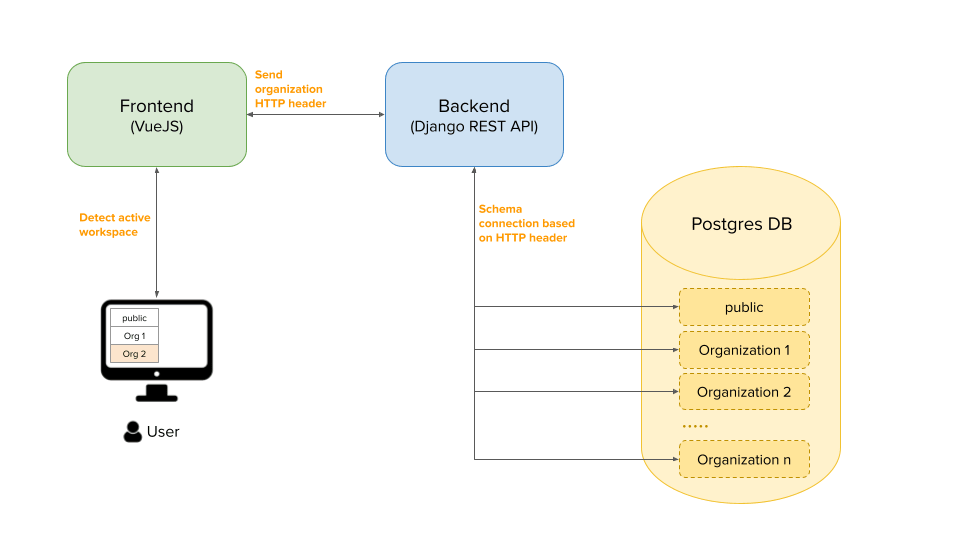
Multi-tenancy only works if the tenant context is explicit and consistently propagated.
In Plio:
Tenant context is resolved once, early, and treated as an invariant. Mistakes surface as errors, not silent data leakage.
Architectural choices only matter if they hold up under change.
What does this isolation model make easier — and what does it make harder — once the system is live?
In practice, this design led to:
These benefits compound as systems grow in scope and responsibility.
This design enabled Plio to:
It deliberately did not optimize for:
Those trade-offs were intentional.
This multi-tenant foundation underpins:
For a deeper technical context, see:
This page focuses on multi-tenant system design and isolation mechanics.
For additional context on how these architectural choices supported real program operations and reporting workflows, see: